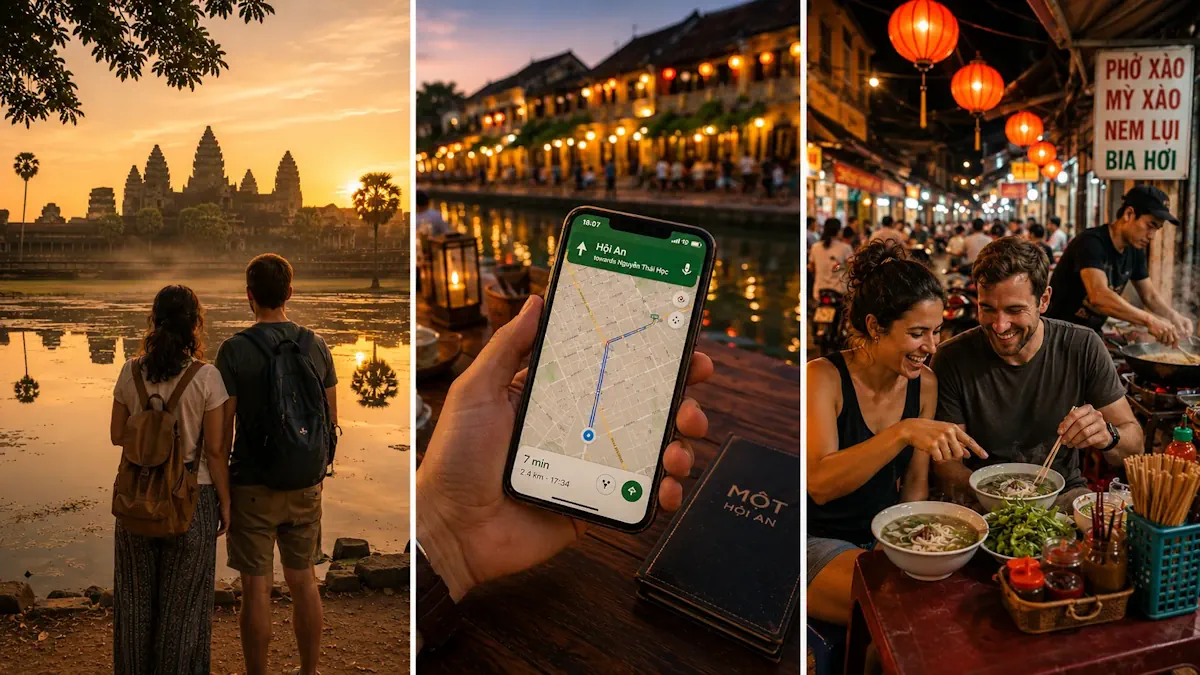
We'd been talking about Southeast Asia for three years. Every January we'd pull up flights, get excited, then talk ourselves out of it. Too complicated. Too far. Too many countries to figure out the logistics for. It was always going to be "next year."
This year, we stopped making excuses. We booked six weeks, five countries, and one very ambitious Google Maps wishlist — and in the weeks before departure, we started worrying about the one thing we'd never properly thought about before: how were we going to stay connected?
On our last big trip — three weeks in Japan — we'd bought a local SIM at Narita. It worked brilliantly. But Southeast Asia is not Japan. We were crossing into five different countries, some of them multiple times. We'd be taking overnight buses, border crossings, domestic flights, and budget ferries to islands where the concept of a mobile carrier shop felt optimistic. The idea of buying and swapping physical SIM cards at every border felt both exhausting and genuinely risky — what happens when you lose one? What happens when the shop at the Cambodian border is closed?
A colleague who'd done the route two years earlier said four words that changed our planning: "Just get an eSIM."
Choosing the eSIM: why we went with Airalo
We spent about a week researching before we left. The market for travel eSIMs has exploded in the last few years — there are dozens of providers now, each with slightly different coverage maps, data allowances, and pricing structures.
The thing that kept pulling us back to Airalo was their regional Asia plan. Instead of buying separate eSIMs for each country — one for Thailand, one for Vietnam, one for Cambodia, and so on — Airalo sells a single "Asia" package that covers the whole region. One QR code. One activation. One data balance that works whether you're in Bangkok or Bali.
We bought 10 GB before departure. The activation process took about five minutes: download the Airalo app, purchase the plan, scan the QR code in your phone's eSIM settings, and you're done. It sits alongside your regular UK SIM — your home number still works for calls and texts, and the Airalo profile handles all your data overseas. The moment the plane landed at Suvarnabhumi and we came through arrivals, our phones showed two bars on the AIS network and our maps loaded instantly. We walked straight past the SIM card kiosks in the arrivals hall without a second glance.
Covers Thailand, Vietnam, Cambodia, Malaysia, Singapore, Indonesia and 10+ more Asian destinations on a single plan. Activate before you fly — data is live the moment you land.
Get the Airalo Asia eSIM →Affiliate link — we earn a small commission at no cost to you. We used this eSIM ourselves and recommend it based on our own experience.
We landed in Bangkok on a Tuesday evening, sweaty and jet-lagged before we'd even left the terminal. The city hit us immediately — the heat, the noise, the sheer scale of it. Bangkok is one of those places that rewards navigation, and navigation in 2026 means Google Maps and real-time transit apps running constantly on your phone. Having data the moment we stepped out of the airport was not a small thing.
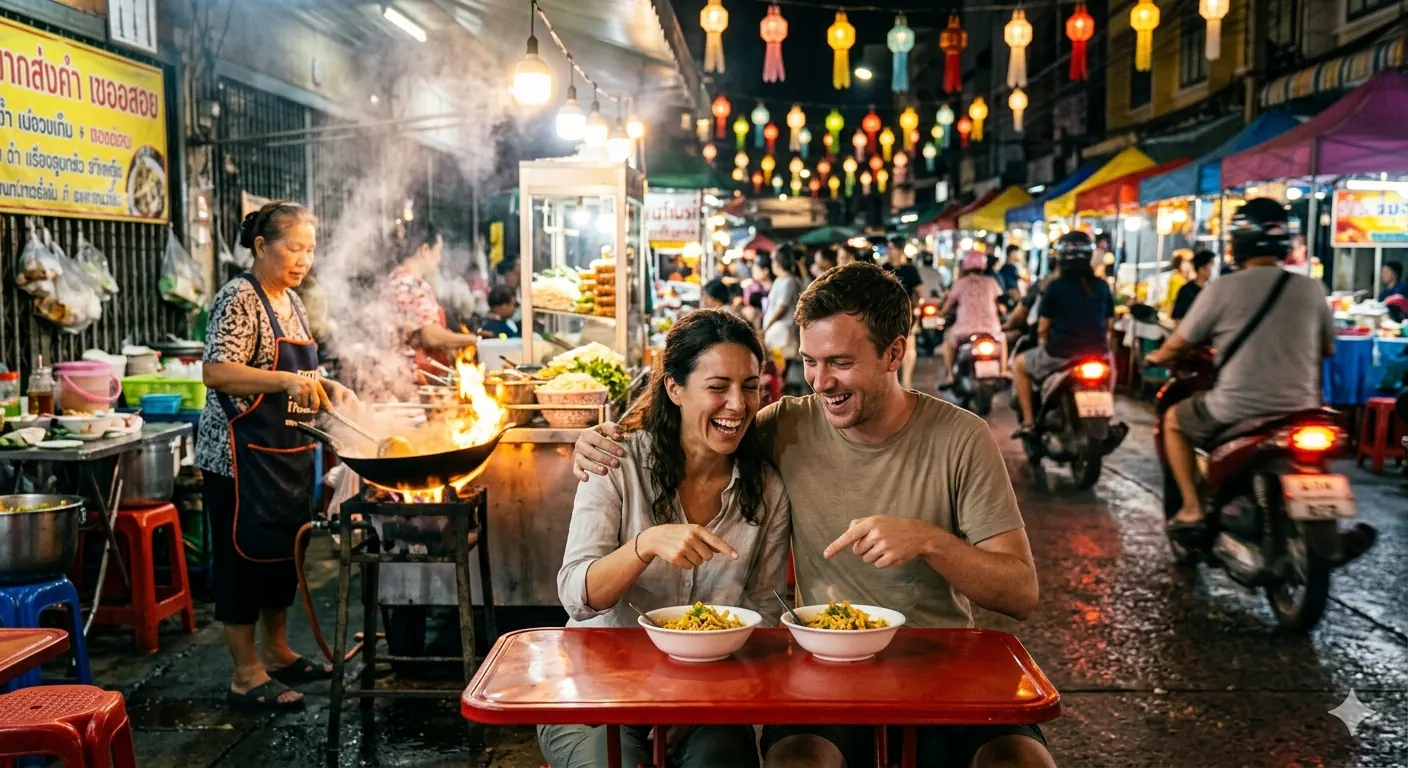
Chiang Mai's Saturday Night Market — the pad see ew we ordered completely blind turned out to be one of the best meals of the trip.
We spent four days in Bangkok. Wat Pho and the Grand Palace in the morning heat. The Chatuchak weekend market, where we spent three hours getting happily lost among 15,000 stalls selling everything from hand-thrown ceramics to vintage military surplus. Long-tail boats up the Chao Phraya to Chinatown, where we ate the best pad see ew of the entire trip at a plastic-tabled restaurant that had no English menu and no internet presence whatsoever — we found it by following locals off the boat.
That last discovery was the eSIM working exactly as it should. Jane was on Google Translate with live camera translation, pointing her phone at the handwritten specials board on the wall while I looked up what the dishes actually were. We ordered completely blind and ate extraordinarily well. None of that works without reliable data — and the AIS network in Bangkok was genuinely excellent, often faster than the café Wi-Fi we occasionally connected to.
Airalo runs on the AIS network in Thailand — the country's largest carrier. 4G LTE throughout Bangkok, including the BTS Skytrain stations, the MRT underground and the river. We saw 5G indicators in parts of the CBD. Not a single drop in four days in the city.
From Bangkok we took the overnight train north to Chiang Mai — a decision we've recommended to every friend who's asked about the trip since. Twelve hours in a sleeper car, waking up to green hills and morning mist as you pull into the station. We used the time to download offline maps (though honestly the train had reasonable Wi-Fi anyway) and plan the next few days.
Chiang Mai was a different pace entirely. The walled old city, the Sunday Walking Street that stretches for what feels like kilometres along Wualai Road, and the temples — so many temples. We spent a morning at Doi Suthep, the hilltop wat that watches over the city, getting there on a red songthaew truck with eight other travellers. The views from the naga staircase at sunrise are the kind of thing you feel bad putting on Instagram because no photo does them justice. We put them on Instagram anyway.
From Chiang Mai we rented a scooter and drove north to Pai, a small town in a mountain valley near the Myanmar border that has been discovered and re-discovered by travellers for thirty years and still somehow retains its charm. The road is legendary — 762 bends in 135 kilometres, which sounds terrifying and is actually just very good fun if you take it slowly. The Airalo data held up throughout the mountain road, which surprised us. We'd expected patchy signal once we got into the hills. It was slower than Bangkok — 3G for stretches — but consistently usable.
We spent three nights in Pai, did absolutely nothing productive, ate too much at the night market, and then flew south from Chiang Mai to Koh Samui for the final Thailand chapter. The island was beautiful and slightly chaotic — the kind of place where the beaches are so good you forgive the tuk-tuk drivers touting for customers every thirty metres. Airalo maintained solid coverage on Samui right down to the beach bars at the south end of Chaweng, which we'd been slightly worried about given the island's geography.
We flew from Bangkok to Hanoi, and the border crossing — for us — was nothing more than the passport control queue at Noi Bai Airport. No SIM swap. No hunting for a phone shop. Before we'd even reached the taxi rank, Airalo had connected to Viettel, Vietnam's network, and our phones were showing full bars.
Hanoi is a city that operates on its own frequency. The Old Quarter, with its 36 ancient guild streets, is genuinely disorienting in the best possible way — narrow lanes, colonial-era shophouses stacked with goods, motorbikes threading through gaps that seem impossible. We spent two full days just walking, following no particular route, occasionally using Maps to find our way back to the guesthouse when we'd lost our bearings entirely. The eSIM earned its keep every single time.
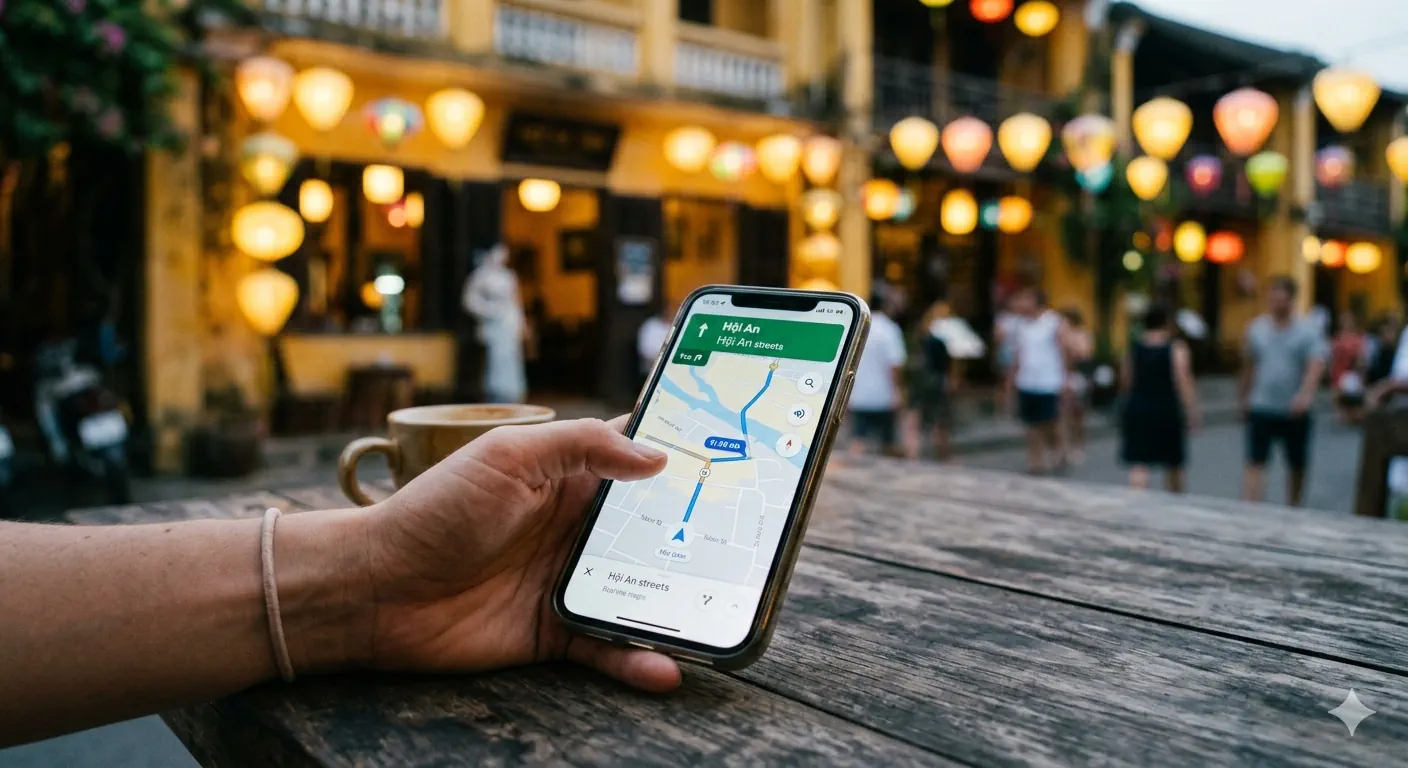
Navigating Hội An's Ancient Town by eSIM — Maps running live in the lantern-lit streets.
The highlight of Vietnam — possibly the highlight of the entire trip — was two nights on a junk boat in Ha Long Bay. The landscape is almost too beautiful to be real: 1,600 limestone karsts rising from emerald water, the whole bay covered by morning mist when you wake at sunrise and climb to the top deck. We kayaked through caves, swam in the bay, ate fresh seafood on a floating restaurant, and barely touched our phones for 48 hours.
"Somewhere between the limestone cliffs and the sound of the boat cutting through still water at 6am, I realised I hadn't worried about connectivity for two days. Which is, I think, exactly the right outcome for an eSIM — it's there when you need it, invisible when you don't."
— Jane, Ha Long Bay, Day 21
From Hanoi we flew south to Da Nang and took a taxi down the coast to Hội An — and if Hanoi is Vietnam at full speed, Hội An is Vietnam at a sigh. The Ancient Town is a UNESCO World Heritage Site and impossibly photogenic: yellow-washed shophouses strung with silk lanterns, the covered Japanese bridge, the Thu Bồn river lined with boats. We stayed three nights and could easily have stayed a week.
Hội An is also where the eSIM proved itself in a genuinely stressful situation. Sam's wallet — with his debit card and a wad of Vietnamese dong — was lost somewhere between the tailor's shop on Tran Phu and the riverside lunch spot. It took about four minutes of iPhone-to-iPhone coordination (me stationary at the restaurant, Sam retracing his steps) to establish that it had been handed in at the tailor's, who'd called the number on Sam's business card. None of that coordination works without instant, reliable data on both phones. We were enormously grateful.
The final leg of Vietnam was Ho Chi Minh City — HCMC, or Saigon, as everyone still calls it. The city is enormous and relentless and thrilling. The War Remnants Museum is harrowing and important. The Ben Thanh market is an assault on every sense simultaneously. The rooftop bars in District 1 are where you go when you need to process all of it with a cold drink in hand and the city spread out below you.
Airalo connects to Viettel in Vietnam — the country's largest network, originally built to military specification. Coverage was outstanding throughout. Hanoi, HCMC and Da Nang all showed 4G LTE. Even in the rural sections between Da Nang and Hội An, signal was consistent. Ha Long Bay's offshore islands had surprisingly usable 4G.
We flew from HCMC to Siem Reap, and Cambodia felt like a gear change. Quieter, less frenetic than Vietnam, the air somehow heavier. Siem Reap itself is a well-organised tourist town built almost entirely around the reason you come: the temples of Angkor.
The Cambodia leg was the one we'd been most uncertain about from a connectivity standpoint. Cambodia is smaller and less developed than Thailand or Vietnam, and we'd read conflicting reports about data coverage outside the main cities. In practice, Airalo's coverage in Siem Reap and throughout the Angkor complex was solid. We were on a Cambodian network (Smart) and while it wasn't the fastest we'd experienced on the trip — 4G that occasionally dipped to a slower speed in more remote temple zones — it was always there.

Sunrise at Angkor Wat — we arrived at 5:15am to beat the crowds. It was worth every minute of the alarm.
We spent three full days at Angkor. Not three mornings, not a quick tick-the-box visit — three entire days of walking, cycling, and occasionally getting very lost in the jungle between temple complexes. Angkor Wat itself needs no introduction: the five towers reflected in the moat at dawn is one of those sights that has been photographed so many times that you wonder if it can still surprise you, and then it does. Bayon — the temple of 216 stone faces — surprised us even more. And Ta Prohm, where the fig trees have swallowed the stones, is the closest thing to a Jurassic Park set that you will find in the real world.
What the eSIM enabled at Angkor, practically speaking, was real-time access to the temple maps and audio guides we'd downloaded via the official Angkor app — which requires an internet connection to authenticate. It also meant that when we discovered, entirely by accident, a small family-run noodle stall at the back of Preah Khan temple at lunchtime, we could look up the name of what we were eating and share the photo with the location tagged. Small things, but they're the texture of a trip.
Airalo connects via Smart in Cambodia. 4G in Siem Reap town and throughout most of the Angkor complex. Some of the more remote outer temples saw slower speeds but were never dead zones. For Siem Reap-based travel, coverage was more than adequate.
Penang arrived in our itinerary slightly by accident — we'd originally planned to fly directly to Kuala Lumpur from Siem Reap, but a long layover in Penang's George Town turned into two extra nights when we realised we hadn't booked anywhere and the city was immediately, obviously wonderful. George Town is a UNESCO-listed multicultural city: Chinese shophouses, colonial-era streets, Tamil temples, and the best street food ecosystem in Southeast Asia. The claim is contested by HCMC and Bangkok, but we've made our position clear.
Malaysia runs on Maxis and Celcom, and Airalo's coverage on both networks was as strong as anything we'd experienced in Thailand. 4G LTE throughout George Town, fast enough to upload the day's photos from the guesthouse rooftop while eating breakfast. The famous street murals of George Town — the iron sculptures and painted-wall artworks scattered across the heritage district — require navigating with a paper map or a decent mapping app. We used Maps constantly, and it never let us down.
The Batu Caves, just outside Kuala Lumpur, were our penultimate stop — 272 steep steps to the Hindu shrine complex inside a limestone hill, coloured monkeys watching from the railings with the expression of creatures who have seen everything. Then two days in KL proper: the Petronas Towers (obligatory, and genuinely impressive), the street food of Jalan Alor, and the kind of luxurious hotel sleep that only feels earned after six weeks of guesthouses.
Malaysia was the best data experience of the trip, matching Bangkok for speed. Penang's George Town and Kuala Lumpur both showed strong 4G throughout. The Batu Caves area, despite being outside the city, maintained consistent 4G — we FaceTimed family from the top of the cave steps with no issues at all.
Singapore was the full stop at the end of the sentence. We took the night bus from KL to the border — a journey of about five hours — crossed on foot at Woodlands, and were in a hotel in the CBD before breakfast. Singapore is a different kind of travel experience from the rest of the trip: expensive, impeccably organised, and possessed of the best public transport system in Asia. We barely needed Maps here because every MRT station has signage so clear it borders on art.
Four days in Singapore: Marina Bay at dusk when the light show on the Supertrees turns the Gardens into something from a science fiction film. The Hawker Centre circuit — Maxwell Road, Lau Pa Sat, Old Airport Road — where we ate our way through char kway teow, Hainanese chicken rice, chilli crab and a laksa that haunted us for days after. Little India and Arab Street and the colonial buildings along the river. And then, on the last evening, a quiet rooftop bar somewhere near Clarke Quay where we looked back at everything the six weeks had been.
Singapore's network — Singtel, which Airalo connects to — is perhaps the best in Asia, and the coverage was as seamless as you'd expect from a city-state that has been building telecoms infrastructure since before most people thought eSIM was a real word. 5G in most of the CBD, 4G everywhere else, zero dead zones in 46 days of use.
The honest verdict on the Airalo eSIM
We talked about the eSIM a lot during those six weeks — probably more than any single item of tech we've ever taken travelling. Not because it was exciting or attention-grabbing, but because of the opposite: it simply worked, everywhere, and we stopped thinking about it.
There are a few things worth knowing before you buy. Airalo plans are data only — your home SIM still handles calls and texts, and most of your communication ends up running through WhatsApp or iMessage anyway when you're travelling. If you need a local number that receives SMS verification codes, that requires a different setup. For the vast majority of travel use cases — Maps, messaging apps, photos, Airbnb, booking platforms, translation, WhatsApp calls — the data-only approach is completely fine.
Top-ups are easy. When we hit around 2 GB remaining midway through Vietnam, we topped up another 5 GB in the app in about two minutes, sitting in a café in Hội An. The data rolled into the existing profile — no new QR code, no reinstall. Seamless.
The app itself is clean and clear. You can see your remaining data, your expiry date, and your connection status at a glance. In six weeks we contacted Airalo support once, about a billing question, and got a response within a few hours.
Total data used over 46 days across five countries: 13.8 GB. Two phones, near-constant background usage, Maps running all day, daily photo uploads, video calls home, translation apps, streaming on a few long bus rides. We'd recommend budgeting at least 10 GB for a similar trip — 15 GB gives comfortable headroom.
"Six weeks, five countries, one eSIM. We landed in Bangkok with it already active and flew out of Singapore with 1.2 GB left. That's the metric that matters — not speeds or carrier names, but whether it got us through the trip without a single connectivity crisis. It did."
— Sam, Singapore Changi Airport, Day 46
Our practical tips for eSIM travel in Southeast Asia
1. Set it up before you fly
The QR code activation takes five minutes on a reliable connection. Do it at home, not in the airport. The eSIM sits dormant until you land, then activates automatically when your phone connects to a local network. You don't need Wi-Fi at the airport — you'll have data the moment you clear the airbridge.
2. Keep your home SIM in as well
Modern iPhones and most flagship Androids support dual-SIM. Keep your home SIM active with data roaming turned off — it still handles calls and texts on your regular number, and your eSIM handles all the data. You don't have to choose between being reachable at home and having affordable data abroad.
3. Download offline maps for each country before you arrive
Even with excellent coverage, offline Maps for each country is a sensible insurance policy for long bus rides, remote temples, and the occasional dead zone in a cave. Google Maps lets you download entire regions. It's free and takes ten minutes. Do it on the airport Wi-Fi before each flight.
4. Budget more data than you think you'll need
Streaming, video calls, the translation app you'll use constantly, background app updates — data usage adds up faster in new countries than at home because you're navigating more and using more apps. We used nearly 14 GB across two phones in 46 days. A single traveller using one phone would use considerably less, but we'd still say 8–10 GB is a sensible floor for a month-long trip.
5. The Airalo app shows exactly what you have left
Unlike some travel SIM providers where you have to text a shortcode to check your balance, Airalo shows remaining data directly in the app dashboard in real time. We checked it every few days. Knowing you have headroom means you use the data you need without anxiously restricting yourself.
Works across Thailand, Vietnam, Cambodia, Malaysia, Singapore, Indonesia, Philippines and more. Activate before you fly. Top up in the app. One eSIM for the whole region.
Get Airalo Asia eSIM →Affiliate link — eSIMs.asia earns a small commission. Sam & Jane used this eSIM throughout their trip independently of eSIMs.asia — this is their own recommendation.
What we'd do differently
Almost nothing, connectivity-wise. If we were doing the trip again, we'd probably buy 15 GB upfront rather than 10 GB plus a top-up, just to avoid the admin in Hội An. We'd also have downloaded the Airalo app on both phones before departure — Jane had to install it on Sam's phone at Suvarnabhumi, which was fine but unnecessary friction.
One thing we noticed: on the rare occasions we were somewhere remote with weak signal, the Airalo app would sometimes show us as connected to a network while Maps struggled to load. This is a limitation of network depth rather than the eSIM itself — if the underlying carrier signal is weak, your data will be slow regardless of which eSIM you're using. In practice it happened perhaps four or five times across 46 days. We drank a coffee and waited it out.
The eSIM format itself — software rather than hardware — is just a better experience for this kind of travel. The anxiety of losing a SIM card, the faff of finding a carrier shop at a border crossing, the confusion of working out which plan to buy in a language you don't read — all of it disappears. You pay once, you activate once, and then connectivity becomes infrastructure rather than a chore. That's exactly what it should be.
Southeast Asia is extraordinary. Go. Book the flights before you find another excuse not to. And sort your eSIM before you pack.
— Sam & Jane, Bristol, June 2026